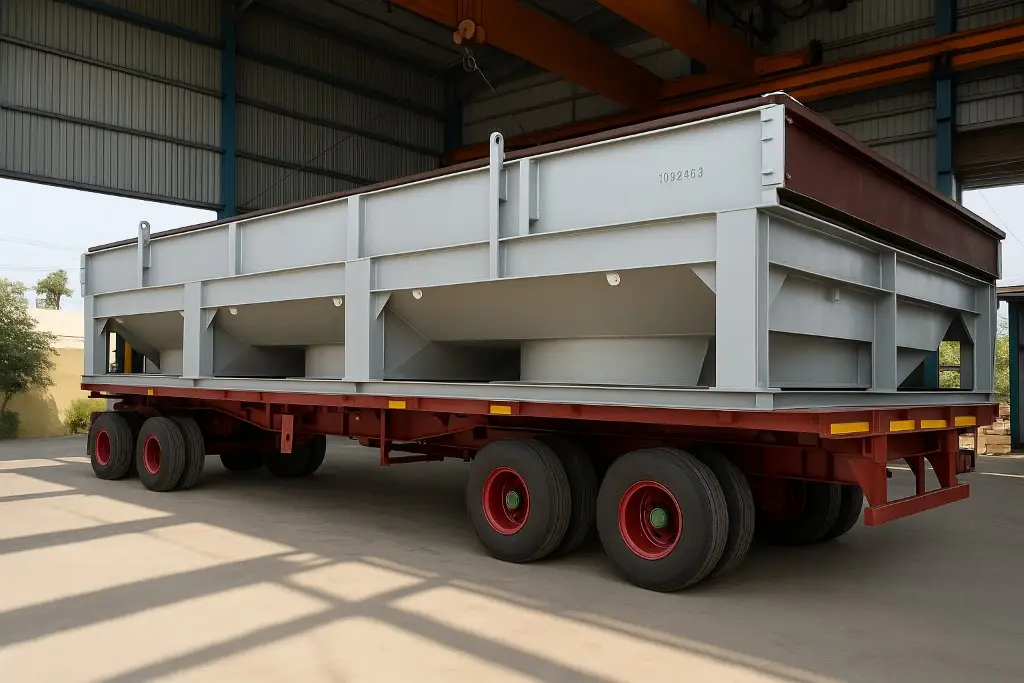
What is a Fin Fan Cooler?
A Fin Fan Cooler, also known as an Air-Cooled Heat Exchanger (ACHE), is a device that uses ambient air to remove heat from a process fluid. Unlike traditional water-based cooling systems, fin fan coolers eliminate the need for cooling towers and water treatment systems, making them more sustainable and cost-effective in many industrial settings.
They are particularly useful in remote, dry, or water-scarce environments where water cooling is not feasible.
Fin Fan Coolers operate on a simple principle: air is blown (or drawn) across finned tubes containing the hot process fluid. The fins increase the surface area, improving the rate of heat transfer from the fluid to the surrounding air.
- Hot process fluid enters the finned tube bundles.
- Ambient air is forced (or pulled) across the tube surface using fans.
- The heat from the fluid transfers through the finned tube walls into the passing air.
- Cooled fluid exits the tube bundle and returns to the process.
- Warm air is released into the atmosphere.
This method ensures reliable, continuous, and eco-friendly heat rejection.
Key Components of a Fin Fan Cooler
Understanding the major components of a Fin Fan Cooler is essential for proper selection, customization, and performance optimization in industrial applications:
| Component |
Function |
| Finned Tubes |
Enhance heat transfer by increasing the surface area exposed to airflow using external metal fins. |
| Tube Bundle |
Group of aligned finned tubes through which the hot process fluid flows for cooling. |
| Fans (Axial or Centrifugal) |
Generate airflow across the finned tubes to facilitate heat dissipation. |
| Plenum Chamber |
Distributes airflow from the fans uniformly across the finned tube bundle to maximize thermal efficiency. |
| Drive System |
Includes motors, belts, or gearboxes that deliver mechanical power to the fans. |
| Headers/Manifolds |
Evenly channel process fluid into and out of the finned tubes for consistent heat exchange. |
| Louvers and Dampers |
Regulate and direct airflow to improve cooling performance and adapt to varying environmental conditions. |
| Support Structure |
Heavy-duty steel framework that supports the entire unit, ensuring stability and durability in harsh conditions. |
Industrial Applications of Fin Fan Coolers
Fin fan coolers are integral in industries where temperature control and continuous processing are essential. Here's how they fit into key sectors:
-
Oil & Gas Industry
- Applications: Gas compression stations, crude oil cooling, hydrocarbon condensation.
- Benefit: Operate reliably in remote and offshore locations with minimal water availability.
-
Petrochemical and Chemical Plants
- Applications: Cooling of hydrocarbons, process solvents, and intermediates.
- Benefit: Withstand corrosive fluids with suitable material choices.
-
Power Generation
- Applications: Turbine oil cooling, generator stator cooling, condensing steam.
- Benefit: Significantly reduces water consumption in power plants, making it ideal for use in water-scarce or arid regions.
-
Refineries
- Applications: Cooling fuel gas, lubricants, and reboilers.
- Benefit: Customizable for high-temperature, high-pressure service.
-
Fertilizer and Urea Plants
- Applications: Ammonia and urea condensation and recovery.
- Benefit: Minimize process contamination with air-side cooling.
-
Metallurgical and Steel Industries
- Applications: Blast furnace cooling, process gas cooling.
- Benefit: Energy-efficient cooling in harsh conditions.
Advantages of Fin Fan Coolers
Fin Fan Coolers offer a wide array of benefits over traditional water-cooled systems:
-
Water-Free Operation
- Eliminate dependency on water supply.
- Ideal for water-scarce regions or where water treatment is costly.
-
Lower Operating Costs
- Reduced energy consumption.
- No water treatment chemicals or cooling towers needed.
-
Eco-Friendly
- Minimize thermal pollution and water wastage.
- Reduce carbon footprint with energy-efficient fans.
-
Long Service Life
- Corrosion-resistant materials and modular design ensure durability.
-
Compact & Modular
- Can be installed in tight spaces.
- Expandable as system demands increase.
-
Low Maintenance
- Minimal mechanical parts.
- Easier to inspect, clean, and replace components.
-
Forced Draft
- Fans are located below the tube bundle.
- Air is pushed through the fins.
- Easy to maintain but sensitive to recirculated hot air.
-
Induced Draft
- Fans are located above the tube bundle.
- Air is pulled through the fins.
- More efficient airflow, better for high-temperature applications.
-
Horizontal vs Vertical
- Horizontal units are more common.
- Vertical units are used when footprint is limited or for better natural convection.
Selection Criteria for Fin Fan Coolers
When designing or purchasing a Fin Fan Cooler, consider:
- Heat load (amount of heat to be removed)
- Fluid type and temperature
- Ambient air conditions (temperature, humidity)
- Space constraints
- Fan power and noise limitations
- Required approach temperature
- Material compatibility (carbon steel, stainless steel, etc.)
At United Cooling Systems, our engineering team assists clients in optimizing fin fan cooler design for peak performance and reliability.
Materials are selected based on fluid corrosiveness, pressure, and temperature:
| Component |
Material |
| Tubes |
Carbon Steel, Stainless Steel, Copper Alloys |
| Fins |
Aluminum, Galvanized Steel, Stainless Steel |
| Frame |
Galvanized or Painted Structural Steel |
| Headers |
Forged Steel, Stainless Steel |
| Fans |
Aluminum (lightweight and corrosion resistant) |
To enhance energy efficiency of your Fin Fan Cooler system:
- Implement variable frequency drives (VFDs) to dynamically control fan speed based on cooling demand.
- Incorporate temperature control systems.
- Install louvers and dampers to optimize airflow.
- Perform regular cleaning of fins and fan blades.
- Use high-efficiency motors and axial fans.
- Client: Natural Gas Processing Facility in Rajasthan, India
- Problem: High energy cost and water scarcity
- Solution: Induced draft Fin Fan Cooler with VFD-controlled fans and aluminum fins
- Results:
- Reduced operating cost by 30%
- Eliminated water usage (saving ~50,000 liters/day)
- Improved plant uptime by 15%
Fin Fan Coolers, or Air-Cooled Heat Exchangers, are essential equipment for modern industry—offering efficient, cost-effective, and environmentally sustainable cooling. Whether you're operating in oil & gas, chemicals, power, or food processing, the advantages of air-cooled systems are clear: lower costs, reduced environmental impact, and minimal maintenance.
At United Cooling Systems, we design, manufacture, and customize Fin Fan Coolers tailored to your operational needs and climate conditions. Our solutions ensure maximum thermal efficiency, long equipment life, and full compliance with industrial standards.
Frequently Asked Questions (FAQ)
-
What is the difference between a Fin Fan Cooler and a Cooling Tower?
Fin Fan Coolers use ambient air to remove heat, while cooling towers use water evaporation.
-
What types of fans are used in Fin Fan Coolers?
Typically, axial flow fans are used for their high efficiency and lower noise levels. Some systems use centrifugal fans in specific configurations.
-
How do I maintain a Fin Fan Cooler?
Regular cleaning of fin surfaces, checking fan alignment, lubrication, motor inspection, and tube integrity checks are essential for long life and performance.
-
Are Fin Fan Coolers noisy?
With modern fan blade designs and optional noise dampeners, noise levels are typically low and compliant with industrial standards.
-
Can I retrofit a Fin Fan Cooler into an existing system?
Yes. Custom-designed units can be engineered to match the performance and footprint of existing cooling systems.
-
What materials are best for corrosive applications?
Stainless steel tubes and aluminum or stainless steel fins are preferred for corrosive fluids or marine environments.
-
What is the typical life expectancy of a Fin Fan Cooler?
With proper maintenance and material selection, a Fin Fan Cooler can last 15–25 years or more.
-
Can Fin Fan Coolers be used in humid climates?
Yes, but performance depends on ambient air temperature. Units must be properly sized to compensate for lower heat rejection capacity in high humidity.