What is a Shell and Tube Heat Exchanger?
A shell-and-tube heat exchanger transfers thermal energy between two fluids without letting them mix. The design centers on a cylindrical outer vessel (the shell) that houses a bundle of narrow tubes. One fluid circulates inside these tubes, while a second fluid moves through the shell space surrounding them. Heat passes from the hotter fluid to the cooler one across the tube walls, which act as the separating and conducting surface. This design dominates in oil refining and heavy chemical processing, largely because the cylindrical shell handles high internal pressures far better than flatter alternatives like plate exchangers.
Tube bundles aren't always simple smooth cylinders — manufacturers sometimes add longitudinal fins to individual tubes to increase surface area and boost heat transfer efficiency without enlarging the whole unit.
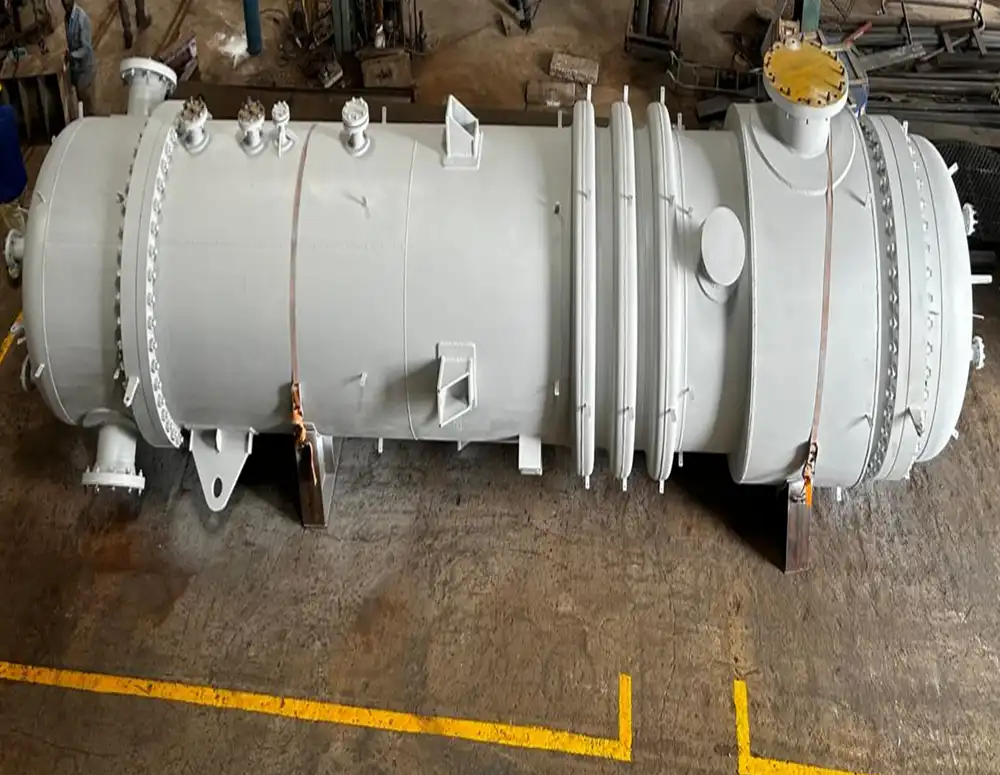
How Heat Transfer Is Optimized
The two fluids typically move in opposite directions through the exchanger (counterflow), which maintains a more consistent temperature gradient along the length of the unit compared to flowing in the same direction. This matters because a steeper, more sustained temperature difference drives faster heat transfer.
Engineers also install baffles — plates positioned inside the shell — to redirect the shell-side fluid so it crosses over the tubes repeatedly rather than flowing straight past them. This zigzag path creates turbulence, and turbulent flow transfers heat more effectively than smooth, laminar flow. Since bundling many tubes together maximizes surface area relative to volume, exchangers can recover and reuse heat that would otherwise be wasted, making them valuable for energy conservation in industrial systems.
Single-Phase vs. Two-Phase Operation
Some exchangers keep both fluids in one state throughout — liquid staying liquid, gas staying gas — described as single-phase operation. Others are built to change a fluid's phase entirely. A unit designed to vaporize a liquid into gas functions as a boiler; one designed to condense vapor back into liquid functions as a condenser. Phase-changing typically happens on the shell side.
Two well-known real-world examples: steam locomotives used large cylindrical shell-and-tube boilers to generate steam, and modern power plants use shell-and-tube condensers to convert spent turbine steam back into liquid water for reuse in the power cycle. Chillers use a similar principle, pairing refrigerant and water on either side of the tubes to move heat in cooling systems.
Structural Design Variations
Tubes connect at their ends to chambers called plenums or water boxes, passing through perforated plates known as tubesheets. From here, tube geometry varies:
- Straight tubes run directly from one end of the shell to the other.
- U-tubes bend back on themselves, entering and exiting from the same end.
U-tube designs are common in nuclear steam generators within pressurized water reactors, where recycled condensate is boiled into steam to drive turbines.
Exchangers are also categorized by how many times the tube-side fluid traverses the shell length — commonly 1, 2, or 4 passes. A single-pass design sends fluid straight through once. Multi-pass designs route it back and forth, which has a practical construction advantage: both the inlet and outlet can be placed on the same end of the unit, simplifying piping. Straight-tube, single-pass configurations are typical for power-plant condensers.
Despite the thermal efficiency advantages of true countercurrent flow, many manufacturers avoid two-pass U-tube designs because they're costlier to build and more prone to failure. As a workaround, several simpler exchangers are sometimes linked together to approximate the performance of one large countercurrent unit.
Baffles supporting the tube bundle are usually mounted to the bundle itself, not the shell — this keeps the whole tube assembly removable as a unit for inspection or cleaning.
Tube material choice balances several competing demands:
- Thermal conductivity — necessary for efficient heat transfer.
- Mechanical strength — tubes experience thermal stress from temperature differentials across their walls, compounded by pressure loads from the fluids.
- Chemical compatibility — the material must resist corrosion from both fluids over long operating periods, accounting for temperature, pressure, and pH conditions.
Common metals include stainless and carbon steel, copper alloys, aluminum, nickel, titanium, and corrosion-resistant superalloys such as Inconel and Hastelloy. For extreme-temperature applications, fluoropolymer tubing (PFA and FEP) is sometimes used instead of metal. Choosing poorly can lead to tube leaks, letting the shell-side and tube-side fluids cross-contaminate or causing pressure loss.
Types of Shell and Tube Heat Exchangers
Based on Flow:
- Single-pass: Fluid passes through the tubes once.
- Multi-pass: Fluid makes multiple passes through the tube bundle for higher heat transfer.
Based on Tube Configuration:
- Straight Tube: Easier to clean, used where fouling is minimal.
- U-tube: Accommodates thermal expansion, compact design.
Key Advantages
- Durability: Built to withstand high pressures, temperatures, and corrosive fluids.
- Flexibility: Supports various fluids, pressures, and flow configurations.
- Efficiency: Large surface area enables high heat transfer rates.
- Customizable: Can be designed for specific pressure drops, flow rates, and space constraints.
- Easy Maintenance: Modular design allows for easy cleaning and tube replacement.
- Carbon Steel
- Stainless Steel
- Copper Alloys
- Titanium (for corrosive fluids)
Materials are chosen based on the fluid, temperature, and how resistant they need to be to corrosion.
Energy Efficiency & Sustainability
Shell and tube heat exchangers contribute significantly to:
- Waste heat recovery
- Fuel savings
- Reduced greenhouse emissions
They're key to making industrial systems more energy efficient and sustainable.
Selection of a shell and tube heat exchanger should be based on the following criteria:
- Operating temperatures and pressures
- Fluid properties (corrosiveness, viscosity)
- Desired heat transfer rate
- Maintenance access
- Space availability
United Cooling Systems offers custom engineering support to tailor heat exchangers to your exact specifications.
- Client: Petrochemical Company
- Challenge: High corrosion and thermal cycling
- Solution: U-tube shell and tube heat exchanger with titanium tubes
- Result: 25% increase in service life and 15% improvement in thermal efficiency
Why Choose United Cooling Systems?
At United Cooling Systems, we manufacture robust and efficient shell and tube heat exchangers tailored to your industry’s unique requirements. With advanced fabrication, material expertise, and global delivery capacity, we ensure:
- Long operational life
- Maximum heat transfer performance
- Low downtime and easy servicing
Get in Touch
Shell and Tube Heat Exchangers are the cornerstone of thermal engineering across various industrial sectors. Their rugged design, adaptability to a wide range of pressures and temperatures, and ability to handle diverse fluids make them an indispensable component in efficient heat transfer systems. Whether it’s refining crude oil, cooling chemical reactions, or optimizing HVAC performance, these exchangers deliver performance, reliability, and cost-efficiency.
At United Cooling Systems (P) Ltd, we specialize in crafting shell and tube heat exchangers tailored to your exact operational demands. With precision manufacturing, superior material selection, and a focus on energy efficiency, we empower industries to achieve sustainable thermal solutions that stand the test of time.
Frequently Asked Questions (FAQ)
-
What makes shell and tube heat exchangers so widely used?
Their versatility, ability to handle high pressure/temperature, and customizable design make them suitable for almost every industry.
-
How often should a shell and tube heat exchanger be serviced?
For industrial use, inspections every 6–12 months are recommended. The presence of fouling or corrosion can increase the need for routine cleaning and maintenance.
-
Can they handle corrosive fluids like acids or seawater?
Yes—when constructed using suitable materials like titanium, stainless steel, or special alloys.
-
Are shell and tube heat exchangers energy efficient?
Absolutely. Their large surface area and customizable design maximize heat recovery and reduce energy losses.
-
What is the typical lifespan of these heat exchangers?
With proper material selection and maintenance, they can last 15–25 years or longer.
-
What’s the difference between U-tube and straight tube designs?
U-tube: More compact, accommodates thermal expansion, harder to clean.
Straight tube: Easier to maintain and well-suited for fouling-prone applications.
-
Can I retrofit a shell and tube exchanger into an existing system?
Yes. United Cooling Systems can design replacement units to match existing footprints and connections.
-
How do I choose the right size or model?
Key selection parameters include heat load, flow rate, fluid properties, and space constraints. Our engineers help design the perfect fit.


