What Is a Stainless Steel Heat Exchanger?
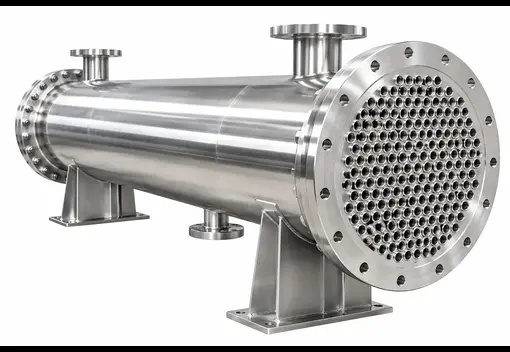
A stainless steel heat exchanger transfers thermal energy between two or more fluids without letting them mix, built using corrosion-resistant grades like SS 304, SS 316, or duplex stainless steel.
Key Types and Designs
- Shell and Tube Heat Exchangers: Consist of a bundle of stainless steel tubes inside a larger shell; ideal for high pressures, heavy industry, oil refineries, and power generation.
- Plate Heat Exchangers: Built from stacked, corrugated stainless steel plates sealed with gaskets or brazed together; popular in HVAC, water heating, and food processing.
- Double-Pipe / Tubular Designs: Compact setups used for specialized or corrosive process fluids.
A
stainless steel heat exchanger is an engineered device that transfers thermal energy from one fluid to another through a solid stainless steel wall, without the two fluids mixing. The fluids can be liquids, gases, steam or two-phase mixtures. The wall can take the form of tubes, plates, coils or spiral sheets, depending on the design.
Heat exchangers are among the most common pieces of equipment in industry. Every time a process needs to be
heated, cooled, condensed, evaporated, pasteurised, sterilised or recovered as waste heat, a heat exchanger is usually involved. They appear in milk plants, breweries, pharmaceutical facilities, refineries, power stations, ships, hospitals, data centres, commercial kitchens and HVAC systems.
When the fluids are corrosive, the temperatures are high, or the product must stay pure and hygienic,
stainless steel is the material of choice. It combines strength, durability, cleanability and corrosion resistance in a way few other engineering materials can match at a reasonable price.
Why Stainless Steel? The Science Behind the Material
Stainless steel is an iron-based alloy containing a
minimum of about 10.5% chromium. The chromium reacts with oxygen in air or water to form an extremely thin, invisible, stable layer of
chromium oxide on the surface. This is called the passive layer.
Three properties make it valuable in heat exchangers:
- Self-healing protection: If the surface is scratched, the passive layer reforms on its own as long as oxygen is available.
- Alloying flexibility: Adding nickel improves toughness and formability. Adding molybdenum improves resistance to chlorides and pitting. Adding nitrogen increases strength. Adding titanium or niobium stabilises the steel at high temperatures.
- Hygienic surface: The dense, non-porous surface does not absorb odours, flavours or bacteria and can be polished to a very smooth finish.
This is why stainless steel is the benchmark material for food, dairy, beverage, pharmaceutical and chemical processing equipment.
How a Stainless Steel Heat Exchanger Works
The basic principle
Heat naturally flows from a hotter body to a colder one. In a heat exchanger:
- The hot fluid flows along one side of a stainless steel wall.
- The cold fluid flows along the other side.
- Heat conducts through the wall from hot to cold.
- Each fluid exits at a new temperature, and the fluids never touch.
The governing equation
Engineers size heat exchangers with the fundamental heat-transfer equation:
Q = U × A × ΔTlm
- Q = heat duty (kW)
- U = overall heat-transfer coefficient (W/m²·K)
- A = heat-transfer surface area (m²)
- ΔTlm = log mean temperature difference between the fluids
To transfer more heat, you can increase the area, raise the temperature difference, or improve the U-value by increasing turbulence and keeping surfaces clean. Plate designs achieve high U-values through corrugated patterns that create turbulence even at low flow rates.
Flow arrangements
- Counter-current flow: Fluids move in opposite directions. This is the most efficient arrangement and allows the closest temperature approach.
- Parallel (co-current) flow: Fluids move in the same direction. It is less efficient but gives more uniform wall temperatures.
- Cross-flow: Fluids move at right angles, common in air-cooled and finned-tube units.
Key performance factors
- Surface area and plate or tube geometry
- Fluid velocity and turbulence
- Fluid properties (viscosity, density, specific heat, conductivity)
- Fouling resistance on both sides
- Thermal conductivity and thickness of the stainless steel wall
Types of Stainless Steel Heat Exchangers
Shell and Tube Heat Exchanger
A bundle of stainless steel tubes is housed inside a cylindrical shell. One fluid flows through the tubes (tube side) while the other flows around them inside the shell (shell side). Baffles direct the shell-side flow across the tubes to increase turbulence and support the tubes against vibration.
Common configurations: fixed tube sheet, U-tube, floating head, kettle reboiler.
Strengths
- Handles very high pressures and temperatures
- Suitable for large duties and dirty or viscous fluids
- Tubes can be plugged, replaced or retubed
- Well-established design codes (TEMA, ASME)
Limitations
- Larger footprint and weight than plate designs
- Lower heat-transfer coefficient, so more surface area is needed
- Space required for tube bundle removal
Typical uses: chemical processing, oil and gas, power plants, steam condensers, oil coolers, refrigeration condensers.
Gasketed Plate Heat Exchanger (PHE)
Thin, corrugated stainless steel plates, usually 0.4 to 0.8 mm thick, are stacked in a frame and sealed with gaskets. Fluids flow through alternating channels, which gives a very large surface area in a small space.
Strengths
- Very high thermal efficiency, with a close temperature approach
- Compact and lightweight
- Easy to open, inspect, clean and expand by adding plates
- Low fouling tendency due to high turbulence
Limitations
- Gasket temperature and pressure limits (commonly up to about 25 bar and 150 to 180 °C depending on gasket material)
- Not ideal for fluids with large particles or fibres
- Gaskets need periodic replacement
Typical uses: dairy pasteurisation, beverage cooling, HVAC, district heating, swimming pool heating, hydraulic oil cooling.
Brazed Plate Heat Exchanger (BPHE)
Stainless steel plates are permanently bonded by vacuum brazing, usually with copper or nickel filler. There are no gaskets or frames.
Strengths: very compact, high-pressure capability, leak-resistant, economical for small to medium duties.
Limitations: cannot be disassembled for cleaning, so it needs clean fluids and good filtration. Copper brazing can be a concern with certain fluids such as ammonia or very aggressive water, where nickel-brazed or fusion-bonded versions are preferred.
Typical uses: refrigeration evaporators and condensers, heat pumps, domestic hot water, compact HVAC systems.
Welded and Semi-Welded Plate Heat Exchanger
Plate pairs are laser or TIG welded, eliminating gaskets on one or both sides. This makes them suitable for
aggressive chemicals, solvents, higher pressures and higher temperatures where elastomer gaskets would fail, while still allowing some degree of cleaning access.
Double Pipe (Tube-in-Tube) Heat Exchanger
A smaller stainless steel pipe runs inside a larger pipe. One fluid flows through the inner pipe, the other through the annular space.
Strengths: simple, robust, handles high pressure and viscous or particulate products.
Typical uses: small duties, sauces, pastes, juices with pulp, pilot plants and sterilisers.
Spiral Heat Exchanger
Two long stainless steel sheets are rolled into a spiral to form two concentric channels. The single-channel flow path produces a self-cleaning effect.
Strengths: excellent for slurries, sludges, fibrous liquids and fouling fluids; compact; good thermal performance.
Typical uses: wastewater, pulp and paper, food slurries, chemical sludges.
Sanitary (Hygienic) Heat Exchanger
Designed to meet food, dairy, beverage and pharmaceutical standards. Features include polished crevice-free surfaces, tri-clamp or DIN connections, full drainability and compatibility with
CIP (clean-in-place) and
SIP (steam-in-place) cycles. Many are tubular, scraped-surface or plate designs built to 3-A or EHEDG principles.
Scraped Surface Heat Exchanger
A rotating blade continuously scrapes the stainless steel wall, preventing product build-up. It is ideal for very viscous, sticky or crystallising products such as ice cream, margarine, chocolate, fondant, peanut butter and dough.
Coil and Immersion Heat Exchangers
Stainless steel coils are immersed in a tank or jacket to heat or cool the contents. They are common in storage tanks, brewing vessels, fermenters, water heaters and process reactors.
Air-Cooled and Finned-Tube Heat Exchangers
Stainless steel tubes, often finned, transfer heat to ambient air moved by fans. They are used where water is scarce, expensive or restricted, such as remote sites, gas compression stations and power plants.
Quick comparison
| Type |
Compactness |
Max Pressure |
Cleaning Access |
Best For |
| Shell and Tube |
Low |
Very High |
Medium |
Heavy industry, steam, high duty |
| Gasketed Plate |
Very High |
Medium |
Excellent |
Hygienic liquids, HVAC |
| Brazed Plate |
Very High |
High |
None (CIP only) |
Refrigeration, heat pumps |
| Welded Plate |
High |
High |
Limited |
Aggressive fluids |
| Spiral |
High |
Medium |
Good |
Slurries, sludge |
| Double Pipe |
Low |
High |
Good |
Viscous or small duties |
| Scraped Surface |
Medium |
Medium |
Good |
Sticky, crystallising products |
Stainless Steel Grades Explained
Choosing the correct grade is one of the most important decisions in heat exchanger design.
Austenitic grades (most common)
SS 304 / 304L
Contains about 18% chromium and 8% nickel. It offers good general corrosion resistance, excellent formability and weldability, and is economical. Suitable for food, beverage, HVAC, potable water and mild chemical duties. It is not recommended for chloride-rich or acidic environments.
SS 316 / 316L
Adds about 2 to 3% molybdenum, which significantly improves resistance to
chlorides, pitting and crevice corrosion. The “L” (low carbon) version reduces the risk of sensitisation during welding. This is the standard grade for pharmaceutical, chemical, marine, coastal and dairy applications with aggressive CIP chemicals.
SS 321
Stabilised with titanium, so it resists intergranular corrosion and performs well at elevated temperatures. Used in exhaust, furnace and waste-heat recovery equipment.
SS 310 / 309
High chromium and nickel for very high-temperature service such as furnace recuperators.
Duplex and super duplex
Duplex 2205
A mixed austenitic-ferritic structure giving roughly twice the yield strength of 316L and strong resistance to
chloride stress corrosion cracking. Common in seawater cooling, offshore, desalination and chemical plants.
Super duplex (2507)
Higher alloy content for the most aggressive chloride environments.
High-performance austenitic
254 SMO / 6% Mo grades: excellent pitting and crevice corrosion resistance for seawater, bleach plants and flue-gas systems.
When to go beyond stainless steel
For extremely aggressive media such as hot chlorides, wet chlorine or strong reducing acids,
titanium, nickel alloys (Hastelloy, Inconel) or graphite may be more suitable.
Grade selection cheat sheet
| Condition |
Recommended Grade |
| Clean water, food, mild conditions |
SS 304 / 304L |
| Chlorides, acids, pharma, coastal sites |
SS 316L |
| High temperature, intergranular risk |
SS 321 |
| Seawater, hot chlorides, high strength needed |
Duplex 2205 / Super Duplex |
| Very aggressive chemicals |
Titanium or Nickel Alloys |
Surface Finish and Hygienic Design
For food, dairy and pharmaceutical use, surface condition is as important as the grade.
- Mill finish (2B): Standard for general industrial use.
- Mechanically polished: Measured by roughness average (Ra). Hygienic applications often specify Ra of 0.8 µm or better; pharmaceutical systems may require 0.4 µm or lower.
- Electropolished: An electrochemical process that smooths micro-peaks, removes embedded contaminants and improves corrosion resistance and cleanability.
Hygienic design principles
- No dead legs, crevices or pockets where product can stagnate
- Fully drainable geometry
- Smooth, ground and polished welds
- Sanitary connections (tri-clamp, DIN 11851, SMS)
- Materials and gaskets that are food-grade or pharmaceutical-grade (EPDM, silicone, FKM, PTFE)
How Stainless Steel Heat Exchangers Are Manufactured
Understanding fabrication helps buyers judge quality.
- Material selection and certification: Raw material with mill test certificates (EN 10204 3.1 is common) and positive material identification (PMI).
- Cutting and forming: Laser or plasma cutting, rolling of shells, pressing of plate corrugations.
- Tube preparation and expansion: Tubes are cut, cleaned, and expanded or welded into tube sheets.
- Welding: TIG, laser or automated orbital welding with qualified procedures (WPS/PQR) and certified welders. Heat input is controlled to avoid sensitisation and distortion.
- Pickling and passivation: Acid treatment removes weld heat tint and embedded iron, and restores the passive layer.
- Polishing: Mechanical or electropolishing for hygienic surfaces.
Testing:
- Hydrostatic or pneumatic pressure test
- Helium or air leak test
- Dye penetrant or radiographic examination of welds
- Dimensional and visual inspection
Documentation: Data book with drawings, material certificates, test reports and conformity declarations.
Key Benefits of Stainless Steel Heat Exchangers
- Corrosion resistance: Protects against moisture, many acids, alkalis and cleaning chemicals when the correct grade is chosen.
- Hygiene and cleanability: Smooth, non-porous surfaces support CIP/SIP and reduce contamination risk.
- Temperature tolerance: Works from cryogenic temperatures to several hundred degrees Celsius.
- High strength-to-weight ratio: Thin plates and walls still withstand pressure, saving material and weight.
- Long life: Often 15 to 25 years or more, giving a low cost per year of service.
- Product purity: No metallic taste, leaching or discolouration in sensitive products.
- Compliance: Accepted by FDA, EU food-contact regulations, 3-A and cGMP frameworks when properly specified.
- Recyclability: Stainless steel is fully recyclable and typically contains a high share of recycled content.
- Aesthetics: Clean appearance for visible installations in kitchens, breweries and show plants.
- Versatility: Available in many grades, designs and sizes, from kilowatts to many megawatts.
Industry-Wise Applications
Food and Beverage
Pasteurisation of juices, sauces and soft drinks; cooling of cooking oil, syrups and wort; cooking and cooling of soups and ready meals; heat recovery from cooking and sterilisation lines.
Dairy Industry
Milk pasteurisation and chilling, UHT treatment, cream and yoghurt processing, cheese-making, whey heating and cooling, regeneration sections that recover heat from hot milk to preheat incoming cold milk.
Breweries, Wineries and Distilleries
Wort cooling, pasteurisation, tank temperature control, glycol cooling of fermenters, heat recovery from brewing kettles.
Pharmaceutical and Biotechnology
Water for injection (WFI) systems, purified water loops, process heating and cooling, fermentation temperature control, sterilisation and CIP heating, clean steam generation.
Chemical and Petrochemical
Process coolers, condensers, reboilers, vaporisers, acid coolers, solvent recovery and reactor temperature control.
Power Generation
Feedwater heaters, steam condensers, lube-oil coolers, waste-heat recovery units, auxiliary cooling systems.
HVAC, Refrigeration and Heat Pumps
Chillers, condensers, evaporators, building heating systems, district heating substations, heat-pump systems, free-cooling plate exchangers separating cooling-tower water from chilled-water circuits.
Marine and Offshore
Jacket-water coolers, lube-oil coolers, central coolers, desalination plants, ballast water treatment (duplex or titanium for seawater).
Water and Wastewater Treatment
Sludge heating, anaerobic digester heating, effluent heat recovery, reverse osmosis system temperature control.
Pulp, Paper and Textile
Black liquor heating, bleach plant heat recovery, dye-bath heating and cooling.
Renewable Energy
Solar thermal loops, geothermal heat extraction, biogas plant digester heating, biomass boilers.
Data Centres and Electronics
Liquid-cooling loops with plate heat exchangers separating facility water from sensitive server cooling circuits.
Hospitals and Laboratories
Steam-to-hot-water converters, sterilisers, autoclave support systems and laboratory process cooling.
Stainless Steel vs Other Materials
| Factor |
Stainless Steel |
Carbon Steel |
Copper / Brass |
Aluminium |
Titanium |
| Corrosion Resistance |
Very Good |
Poor |
Good (limited in ammonia, some acids) |
Moderate |
Excellent |
| Thermal Conductivity |
Moderate |
Moderate |
Very High |
High |
Low |
| Hygienic Suitability |
Excellent |
Poor |
Moderate |
Moderate |
Excellent |
| Strength at Temperature |
High |
High |
Moderate |
Lower |
High |
| Weight |
Medium |
Medium |
Heavy |
Light |
Light |
| Initial Cost |
Medium |
Low |
Medium to High |
Low to Medium |
High |
| Lifespan in Harsh Duty |
Long |
Short |
Medium |
Medium |
Very Long |
Key insight: Although stainless steel conducts heat less efficiently than copper or aluminium, thin plates, high turbulence and cleaner surfaces over time usually offset this. The overall heat-transfer coefficient is often limited more by the fluid films and fouling than by the wall itself.
Design Considerations for Engineers
Thermal design
- Define the duty, flow rates, inlet and outlet temperatures and required temperature approach.
- Include realistic fouling factors so the exchanger performs after months of operation, not only when new.
- Balance higher velocity (better heat transfer, less fouling) against higher pressure drop and pumping cost.
Mechanical design
- Design pressure and temperature must cover upset conditions, start-up, shutdown and cleaning cycles.
- Use floating heads, U-tubes or expansion bellows to absorb thermal expansion.
- Prevent flow-induced tube vibration with correct baffle spacing and supports.
- Consider corrosion allowance and fatigue from thermal cycling.
Material and corrosion considerations
- Chloride stress corrosion cracking (SCC): Austenitic grades can crack when exposed to chlorides, tensile stress and temperatures above about 50 to 60 °C. Duplex grades resist this far better.
- Pitting and crevice corrosion: Avoid stagnant zones and consider higher molybdenum content.
- Galvanic corrosion: Prevent contact between dissimilar metals in the presence of electrolytes.
- Intergranular corrosion: Use low-carbon (L) or stabilised grades for welded parts.
Hygienic design
- Fully drainable, smooth, crevice-free, CIP-ready.
- Suitable gasket materials for the product and cleaning chemicals.
Operability
- Provide vents and drains, isolation valves, bypasses and instrumentation (temperature, pressure, flow).
- Plan access for cleaning, tube pulling and plate-pack opening.
- Consider modular or expandable designs for future capacity increases.
How to Choose the Right Stainless Steel Heat Exchanger
Follow this step-by-step process:
Step 1: Define the process duty. Heat load, flow rates, temperatures, allowable pressure drop, operating hours.
Step 2: Characterise both fluids. Composition, corrosiveness, chloride level, pH, viscosity, solids content, fouling tendency, scaling potential and any hazards.
Step 3: Determine pressure and temperature limits. Include maximum design and test conditions.
Step 4: Choose the exchanger type.
- Clean liquids, limited space, high efficiency → plate
- High pressure, high temperature, large duty → shell and tube
- Slurries, fibres, sludge → spiral
- Sticky or very viscous products → scraped surface or double pipe
- Refrigerant duties, compact packages → brazed plate
Step 5: Select the grade. Match to chlorides, acids and temperature (see the grade table in Section 5).
Step 6: Confirm hygiene and finish needs. Ra value, electropolishing, 3-A or EHEDG compliance, sanitary connections.
Step 7: Check standards and certifications. ASME, TEMA, PED/CE, 3-A, FDA, cGMP, IBR (in India for boilers and steam applications), or other local regulations.
Step 8: Consider space, weight and installation. Footprint, floor loading, access clearance and piping layout.
Step 9: Plan cleaning and maintenance. Choose between CIP-only or openable designs and confirm spare parts availability.
Step 10: Evaluate total cost of ownership. Compare purchase price against energy recovery, water savings, cleaning frequency, downtime risk and service life.
Step 11: Evaluate the manufacturer. Ask about references in your industry, in-house testing, quality certifications (ISO 9001), after-sales support and typical lead times.
Standards, Codes and Certifications
| Standard / Certification |
Relevance |
| ASME Section VIII Div. 1 |
Pressure vessel design and fabrication |
| TEMA |
Shell and tube construction and tolerances |
| PED 2014/68/EU (CE Marking) |
European pressure equipment compliance |
| API 660 / API 662 |
Refinery shell and tube and plate heat exchangers |
| 3-A Sanitary Standards |
Dairy and food equipment hygiene |
| EHEDG |
European hygienic engineering guidelines |
| FDA / EU 1935/2004 |
Food-contact materials |
| cGMP / ASME BPE |
Pharmaceutical and bioprocessing equipment |
| ISO 9001 / ISO 14001 |
Quality and environmental management |
| IBR (India) |
Boiler-related pressure equipment |
| NACE / ISO 15156 |
Sour service materials, where applicable |
| EN 10204 3.1 |
Material test certification |
Always confirm which standards apply in your country and industry before ordering.
Installation Best Practices
- Foundation and support: Use a level, rigid base. Avoid transmitting pipe loads to the exchanger nozzles.
- Orientation: Install according to the manufacturer’s guidance. For example, horizontal shell and tube units need proper drainage slope, and plate units should have venting at high points.
- Piping: Install isolation valves, strainers (especially upstream of plate and brazed units), vents, drains and bypass lines.
- Thermal and pressure protection: Fit safety relief valves where required and avoid thermal shock from sudden hot-fluid introduction.
- Gradual start-up: Open the cold side first and slowly introduce the hot side to prevent thermal shock and water hammer. Vent air fully.
- Instrumentation: Install temperature and pressure gauges on all inlets and outlets so performance can be trended over time.
- Flushing and commissioning: Flush piping before connecting the exchanger to avoid debris, weld slag and scale entering narrow channels.
- Insulation: Insulate hot surfaces for energy savings and operator safety.
Maintenance, Cleaning and Passivation
Preventive maintenance
- Record inlet and outlet temperatures, pressures and flows regularly.
- Watch for rising pressure drop or declining temperature approach, the early signals of fouling.
- Inspect gaskets, bolts and connections during planned shutdowns.
- Maintain good water quality: control chlorides, pH, hardness and dissolved oxygen, and use appropriate treatment or filtration.
- Use strainers or filters to protect narrow plate channels.
Cleaning methods
- CIP (Clean-in-Place): Circulate cleaning solutions without dismantling. A typical sequence is a water rinse, alkaline wash to remove organics, water rinse, acid wash to remove mineral scale, and a final rinse. Concentrations, temperatures and contact times must suit the grade and gaskets.
- Manual or mechanical cleaning: Open plate packs and clean plates with soft brushes and low-pressure water. For shell and tube units, use rod cleaning, brush cleaning or hydro-jetting.
- Chemical descaling: Select inhibited acids or proprietary cleaners compatible with stainless steel and gaskets. Rinse thoroughly afterwards.
What to avoid
- Hydrochloric acid and strong chloride-based cleaners, especially warm, which can cause pitting and stress cracking
- Bleach or chlorinated cleaners left in contact for long periods
- Steel wool, wire brushes or carbon steel tools that embed iron particles and cause rust spotting
- wStagnant, untreated water left in the unit during long shutdowns; drain, rinse and dry instead
Passivation
After welding, repairs, heavy mechanical cleaning or contamination, passivation with nitric or citric acid removes free iron and helps restore the protective chromium oxide layer. Follow recognised procedures such as ASTM A967.
Gasket care (plate exchangers)
- Replace gaskets when they harden, crack, swell or leak.
- Match gasket material (NBR, EPDM, FKM, silicone, PTFE-coated) to temperature and fluid compatibility.
- Tighten plate packs evenly to the specified dimension.
Long-term shutdown
Drain, rinse with clean water, dry, and keep openings capped. For wet layup, use treated, low-chloride water.
Troubleshooting Common Problems
| Symptom |
Likely Cause |
Recommended Action |
| Poor heat transfer |
Fouling, scaling, air pockets, low flow |
Clean, vent, check flows and pumps |
| High pressure drop |
Blocked channels, debris, excessive flow |
Backflush, strain upstream, clean mechanically |
| External leak |
Gasket failure, loose bolts, cracked weld |
Re-tighten, replace gaskets, repair weld |
| Internal cross-leak (fluids mixing) |
Pinhole from pitting or cracking, plate damage |
Pressure test, locate leak, replace plates or tubes |
| Pitting or rust spots |
Chlorides, iron contamination, stagnation |
Clean and passivate, upgrade grade, improve flow |
| Stress corrosion cracking |
Chlorides + heat + tensile stress |
Switch to duplex or higher alloy, reduce temperature |
| Vibration or noise |
Excess velocity, loose supports |
Reduce flow, add supports, check baffles |
| Temperature instability |
Control valve issues, uneven flow distribution |
Check valves, strainers and piping layout |
| Premature gasket failure |
Wrong material, over-temperature, chemical attack |
Select compatible gasket, check operating conditions |
Energy Efficiency and Sustainability
Heat exchangers are one of the most effective tools for cutting industrial energy use and emissions.
- Heat recovery: Capture heat from hot exhaust, condensate, effluent and process streams to preheat incoming fluids.
- Regenerative systems: In dairy and juice pasteurisation, regeneration sections can recover a large share of the heat, often upwards of 90% in well-designed plate systems, sharply reducing steam and chilling demand.
- Boiler efficiency: Economisers and feedwater preheaters reduce fuel consumption.
- Reduced water use: Efficient closed cooling loops lower freshwater demand.
- Lower carbon footprint: Less fuel and electricity consumption means lower CO₂ emissions.
- Heat-pump integration: Compact plate exchangers are core components in modern heat pump and district-energy systems.
- Circular materials: At end of life, stainless steel is highly recyclable.
Tip: Even modest improvements in temperature approach or fouling control can translate into significant yearly savings in plants with continuous operation.
Cost and Total Cost of Ownership (TCO)
The purchase price is only one part of the cost picture.
Factors that influence initial cost
- Type (plate, shell and tube, spiral, sanitary)
- Grade (304 < 316L < duplex < super duplex < titanium)
- Surface area and size
- Design pressure and temperature
- Certification and documentation requirements
- Surface finish and special testing
- Customisation and lead time
Factors that influence lifetime cost
- Energy recovered or wasted
- Pumping power (pressure drop)
- Cleaning chemicals, labour and downtime
- Gasket and spare parts replacement
- Expected life and risk of premature failure
Practical advice: A slightly higher investment in the correct grade (for example 316L instead of 304 in a chloride environment) or a better design with lower fouling often pays back many times over through longer life and fewer shutdowns.
Trends in Heat Exchanger Technology
- Compact and high-efficiency designs: Advanced plate patterns and welded or laser-welded plates for tougher duties.
- Digital monitoring: Sensors and analytics to track fouling and predict cleaning needs, supporting predictive maintenance.
- Heat pump and electrification growth: Rising demand for compact stainless steel plate exchangers in low-carbon heating and cooling.
- Waste-heat valorisation: Greater focus on capturing low-grade heat from industrial processes and data centres.
- Improved alloys and coatings: Better resistance to chlorides and fouling.
- Additive manufacturing: Emerging for complex, optimised geometries in specialised applications.
- Hygienic and automated cleaning: More efficient CIP designs and reduced chemical and water use.
Frequently Asked Questions (FAQ)
1. What is a stainless steel heat exchanger used for?
It transfers heat between two fluids for heating, cooling, condensing, evaporating, pasteurising or heat recovery, in industries from food and pharma to chemicals, power and HVAC.
2. What is the difference between SS 304 and SS 316L heat exchangers?
SS 316L contains molybdenum, giving much better resistance to chlorides, acids and pitting, plus better weldability due to low carbon. SS 304 is more economical and fine for mild conditions.
3. Which is better: plate or shell and tube?
Plate exchangers are more compact and efficient for clean liquid-to-liquid duties at moderate pressures and temperatures. Shell and tube exchangers are better for high pressure, high temperature, large capacity or dirtier fluids.
4. How long does a stainless steel heat exchanger last?
Commonly 15 to 25 years or more with the right grade, good water quality and regular maintenance. Plate gaskets usually need replacing every few years depending on service.
5. Can stainless steel heat exchangers handle seawater?
Standard 304 and 316L are generally unsuitable for warm seawater because of chloride attack. Duplex, super duplex, 6% molybdenum grades or titanium are better options.
6. Are stainless steel heat exchangers food safe?
Yes. Food-grade stainless steel (typically 304 or 316L with a suitable finish) is non-reactive, easy to sanitise and widely accepted by food-safety regulations when built to hygienic standards.
7. How often should a heat exchanger be cleaned?
It depends on fluid, temperature and fouling rate. Rather than fixed intervals, many plants clean based on performance indicators such as pressure drop and temperature approach.
8. What cleaning chemicals are safe for stainless steel?
Mild alkaline detergents, nitric acid and citric acid (at suitable concentrations and temperatures) are commonly used. Avoid hydrochloric acid and chlorine-based cleaners at high concentrations or temperatures.
9. Can a leaking heat exchanger be repaired?
Often yes. Tubes can be plugged or replaced, plates can be re-gasketed or replaced, and welded areas can be repaired. Brazed plate units are generally not repairable.
10. Why is my heat exchanger losing efficiency?
The most common cause is fouling or scaling. Other causes include trapped air, reduced flow, gasket or flow-distribution problems, or changes in process conditions.
11. What is the passive layer on stainless steel?
A thin, self-healing chromium oxide film that forms naturally on the surface and protects the metal beneath from corrosion.
12. What is passivation and why is it needed?
Passivation is a chemical treatment that removes free iron and contaminants from the surface and promotes a uniform passive layer. It is especially important after welding, fabrication or repairs.
13. What is the maximum temperature for a stainless steel plate heat exchanger?
The limit is mostly set by the gasket. EPDM and NBR gaskets typically allow about 130 to 150 °C, while welded or brazed designs can go higher. Always check the manufacturer’s rating.
14. How do I size a heat exchanger?
Provide duty, flow rates, inlet and outlet temperatures, fluid properties, allowable pressure drop and fouling expectations. Manufacturers use thermal design software to calculate required area and configuration.
15. What standards should a heat exchanger comply with?
It depends on the application. Common ones include ASME Section VIII, TEMA, PED/CE, 3-A for dairy, FDA or EU food-contact rules, and cGMP for pharmaceutical use.
16. Can I add capacity to a plate heat exchanger later?
Yes, in many gasketed designs you can add plates to the frame if the frame length and pressure ratings allow it. This is a major advantage over brazed or fixed designs.
17. How do I prevent corrosion in a stainless steel heat exchanger?
Choose the right grade, keep chloride levels controlled, avoid stagnant conditions, clean regularly with compatible chemicals, drain and dry during shutdowns, and passivate after fabrication or repair.
Conclusion
A stainless steel heat exchanger is much more than a piece of process hardware. It is a long-term investment in efficiency, product quality, safety and sustainability. By understanding the available types (plate, shell and tube, spiral, sanitary, brazed), selecting the correct grade (304, 316L, duplex or beyond), and following good practice in design, installation, cleaning and passivation, you can achieve decades of reliable performance and significant energy savings.
Whether you operate a dairy, brewery, pharmaceutical plant, chemical facility, power station or HVAC system, the key is to match the exchanger to your fluids, conditions and hygiene needs, and to judge cost by lifetime value rather than purchase price alone.
